The before-and-after test shows what a setup is worth in five minutes
Somebody on your team, or your partner, or the voice in your own head, is going to ask whether the afternoon you spent onboarding Claude was worth it. Here is the five-minute answer, and it is the same test the whole course is built around.
You run one real request twice, once with nothing behind it and once inside your setup. Then you put the two results side by side and score them. You do not have to explain what a rules file is or what a skill does. The pair explains it.
The test
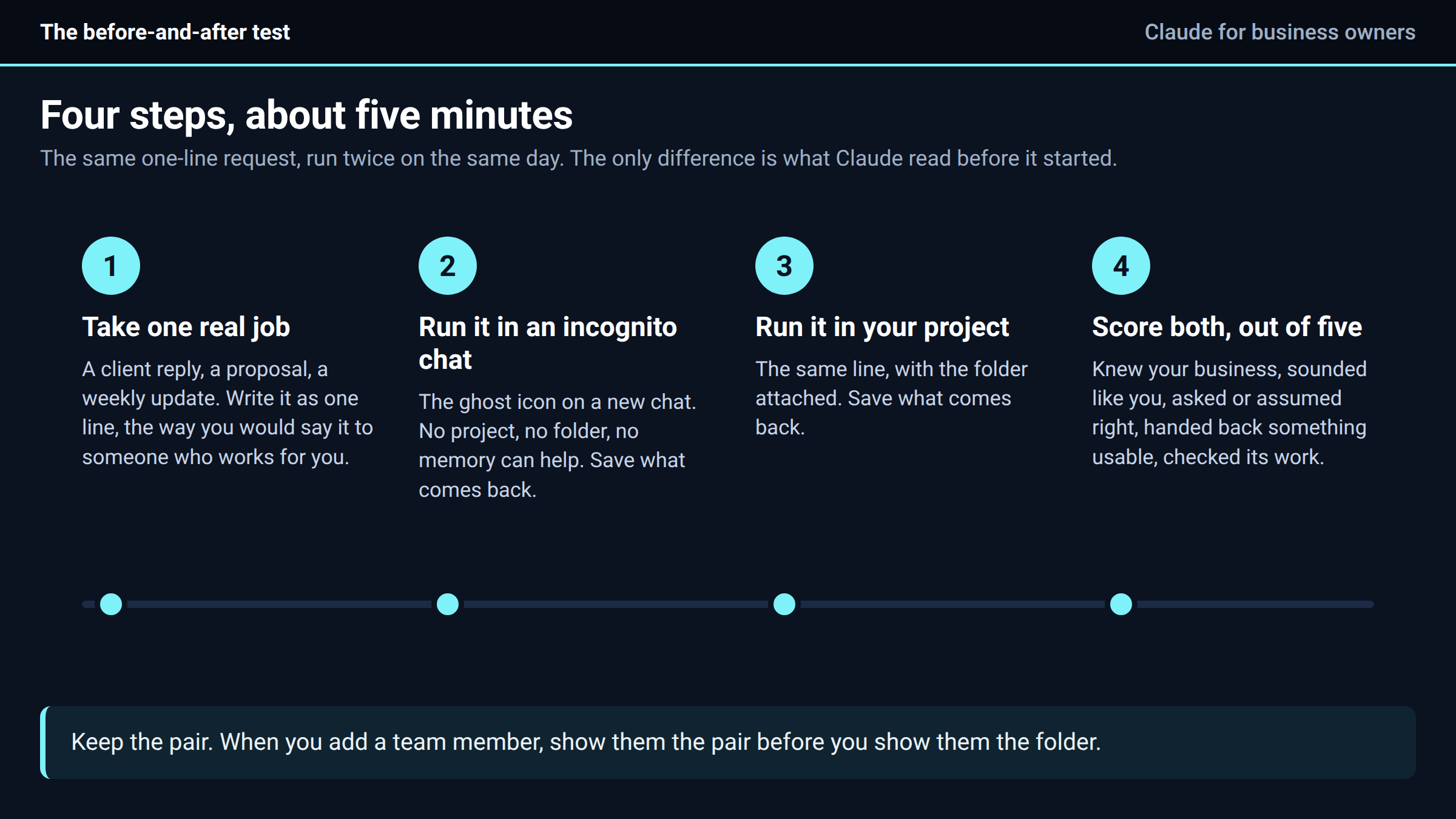
Take one real job. It can be a client reply, a proposal or a weekly update, whatever is next on your list anyway. Write the request as one line, the way you would say it to a person who already works for you.
Run that line in an incognito chat first. On claude.ai it is the ghost icon at the top right of a new chat. Anthropic's help center, read on September 29, 2026, says an incognito chat is not saved and not remembered, so no project, no folder, no instructions and no memory can help. That is the point. It is Claude with nothing behind it, which is what most people have been using all year. Save what comes back.
Then run the same line inside your project, with the folder attached. Save what comes back.
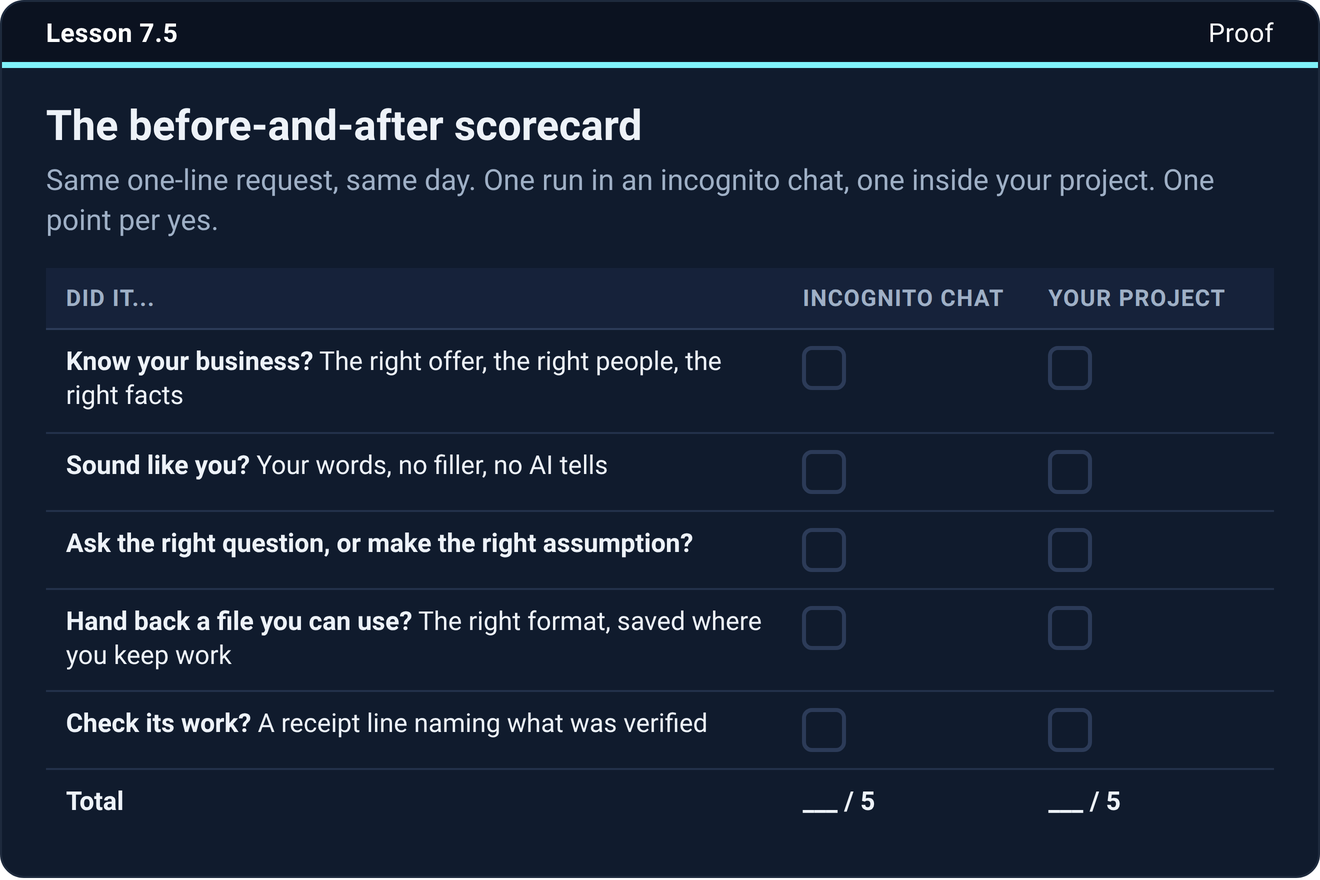
Now score the two on five points. Did it know your business, meaning the right offer, the right people and the right facts. Did it sound like you, with your words and no AI tells. Did it ask the right question or make the right assumption. Did it hand back something you can use, in the right format, saved where you keep work. Did it check its work and tell you what it checked. One point per yes, out of five, for each run.
One pair, on a made-up business
The course runs the test on Northline Landscaping, a business we made up for the course so the pictures could show real files without showing anyone's real customers. It is a test run, not a customer result, and I want to be plain about that before you look at it.
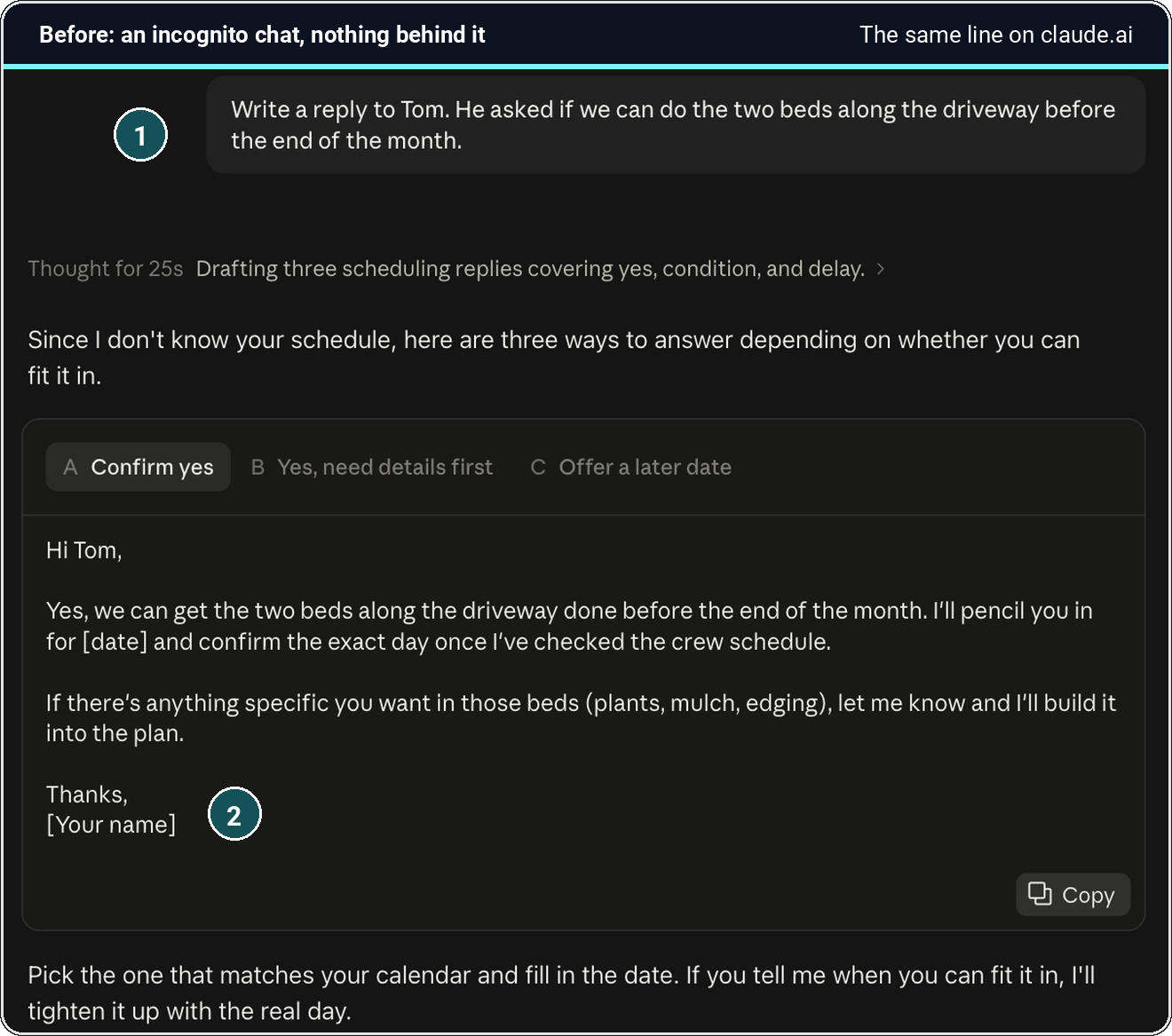
The line was, "Write a reply to Tom. He asked if we can do the two beds along the driveway before the end of the month."
In the blank chat, Claude thought for a while and then said it did not know the schedule, so here were three ways to answer. It handed back three tabs, one to confirm yes, one to ask for details first, one to offer a later date. The reply under the first tab was polite and had a blank where the date goes and another blank where the name goes. Then it asked which one matched the calendar. That is a new hire on the first morning. It is trying, and it has no idea who Tom is, what the job costs or how the owner talks.
Inside the Northline project, the same line came back as one reply in the owner's voice, with the real quote for those two beds pulled from her own note in the business files. Before writing it, Claude read the rules, the current-state file and the business files, and loaded the two skills for writing in her voice and checking it. Underneath the reply it listed what it assumed, including that it could not check the calendar because the calendar connector was signed into a different account. It said nothing was sent and the reply was there to paste. And it ended with a line naming what it checked, which was the question answered first, no banned words, and the opener, sign-off and length matching her voice sample.
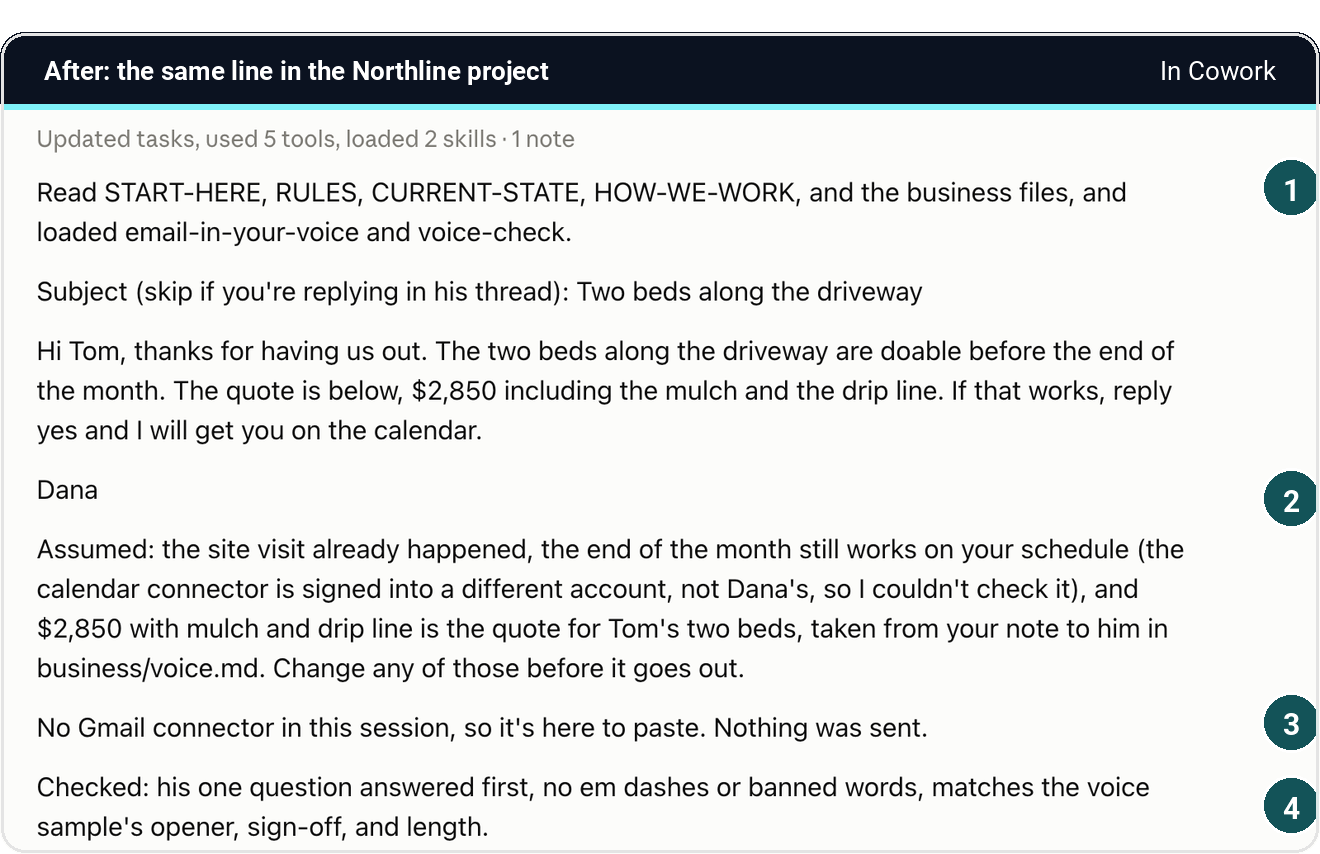
Score the pair yourself. The first run gets one point at best, for asking a reasonable question. The second one gets five.
What the pair shows, and what it does not
The pair is not a claim that the second run is a better model. It is the same model on the same day with the same line. The only difference is what it read before it started. That is the whole argument for the setup, and it is why the course calls it onboarding rather than prompting. A new hire and a trained employee have the same brain, and one of them has read the handbook.
It also shows what people get wrong about a good result. The one that sounds most confident is not the good one, and the blank chat sounded fine. The good one knows what it does not know and says so, which is why the assumptions line and the checked line are two of the five points. If your second run does not carry those two lines yet, that is the next thing to fix in your rules file, and it is a two-line fix.
Keep the pair
Save both results in your deliverables folder with the date. When you add a team member, show them the pair before you show them the folder. It explains the point faster than any lesson, and it is what to look at on the day you wonder whether to keep up the weekly upkeep.
If the second run scores three out of five, treat it as a list rather than a failure. Whatever it missed is a fact or a rule that is not in a file yet. Put it in and run the test again next month. The score goes up and the folder gets better, and both of those happened because you spent five minutes.
Do it today
Pick the next real thing on your list. Run it in an incognito chat, then in your project, and score the two. If you have not done the setup yet, run only the first half and keep it, because that is your before, and you will want it later.
Then post your pair in the community. A before and after from a real business, even with the names covered, is worth more to the next member than anything I can write here.
The next step
Run the test this week on one real job, and keep both results.
The test prompt, the scorecard and the setup that produces the second run are all in the course inside Teach Claude Your Business, where you onboard Claude like a new hire in one sitting and keep everything it builds. It is free to join.
Join Teach Claude Your Business
Sources: Use Claude's chat search and memory to build on previous context, Claude help center, read September 29, 2026, for what an incognito chat does and does not keep. The test, the scorecard and the Northline pair are from Onboard Claude lesson 7.5. Northline Landscaping is a made-up business built for the course, and the pair is a test run, not a customer result.

