
Which Claude should you use? Start on Sonnet and move up when it struggles
There is a small piece of text next to the send button in Claude. It reads something like Sonnet 5 High, or Opus 5 Max. Most people never click it, and it has been sitting on whatever the last thing set it to, which may not have been you.
That control holds three settings. Which Claude you are talking to, how hard it works on each answer, and whether it thinks the problem through before it writes. All three change what comes back, and all three change how fast you use up what your plan gives you each week. This post is the first one, which Claude to use. The other two get their own post.
The four models, in plain words
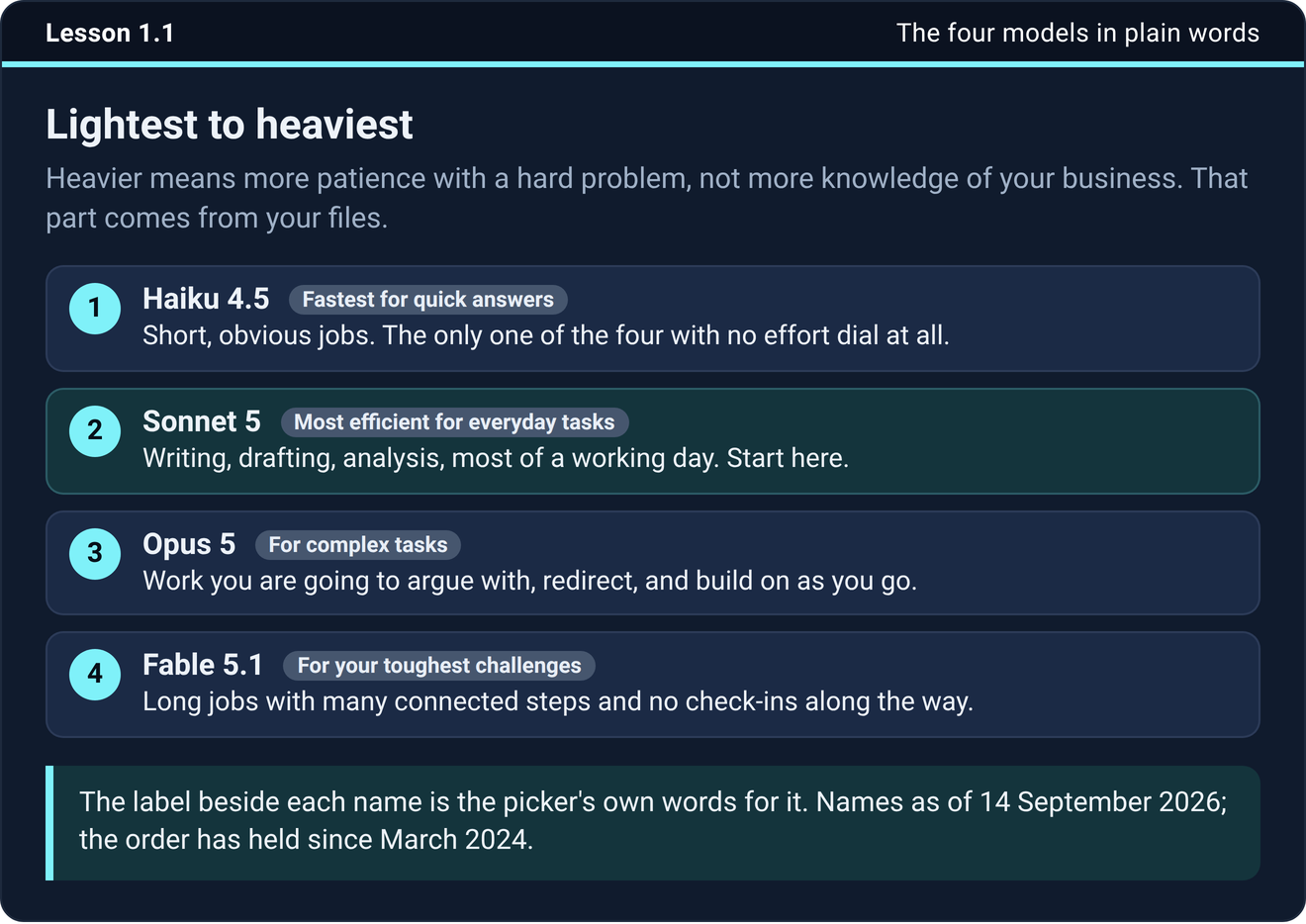
Anthropic gives each model one line in the picker, and those lines are the fastest way in. As of September 2026 the four are Haiku 4.5, Sonnet 5, Opus 5, and Fable 5.1. The names will change, and I say what to do about that at the end.
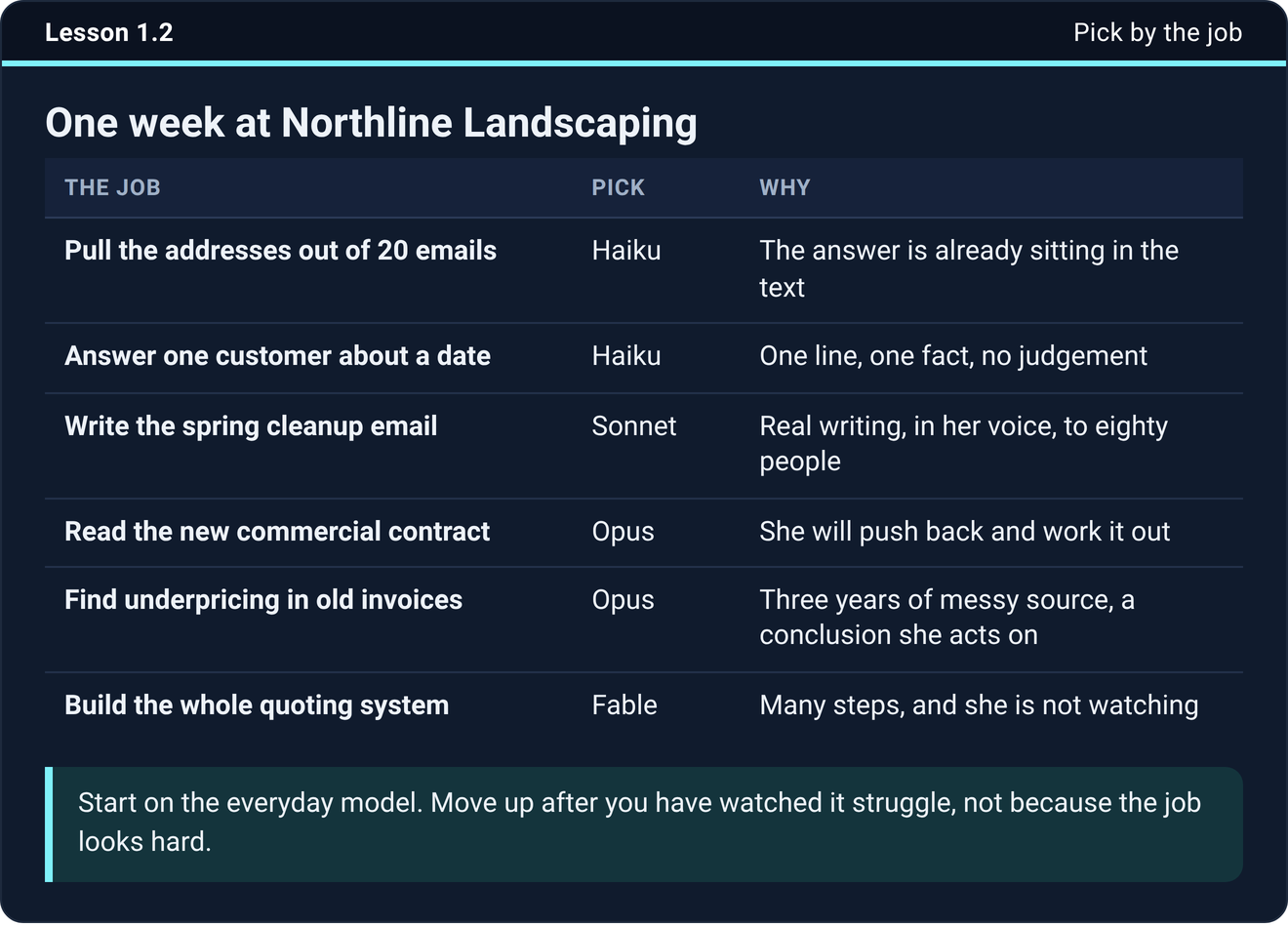
Haiku is the fastest, for quick answers. It is for short, obvious jobs where you already know the shape of the answer, like pulling the dates out of twenty emails or sorting a list.
Sonnet is the everyday one. Writing, drafting, cleaning up data, and most of what a business owner asks for in a day. This is the one to start on.
Opus is for complex work. Work you are going to argue with, like reading a contract, digging into numbers that do not add up, or planning something with a lot of moving parts.
Fable is for the toughest jobs. Long work with many connected steps that you would rather describe once and let it run without you.
Heavier does not mean smarter about your business
The heavier models are not better at knowing who your customers are or how you write. That comes from your instructions and your files. What the heavier models buy you is patience, meaning more willingness to work a problem, check their own answer, and keep going without you standing there.
So running everything on the heaviest one is not a shortcut. Anthropic says the same in its own guide. Using Opus on a task Haiku could handle costs you tokens for no gain and slows you down.
Two rules cover almost everything
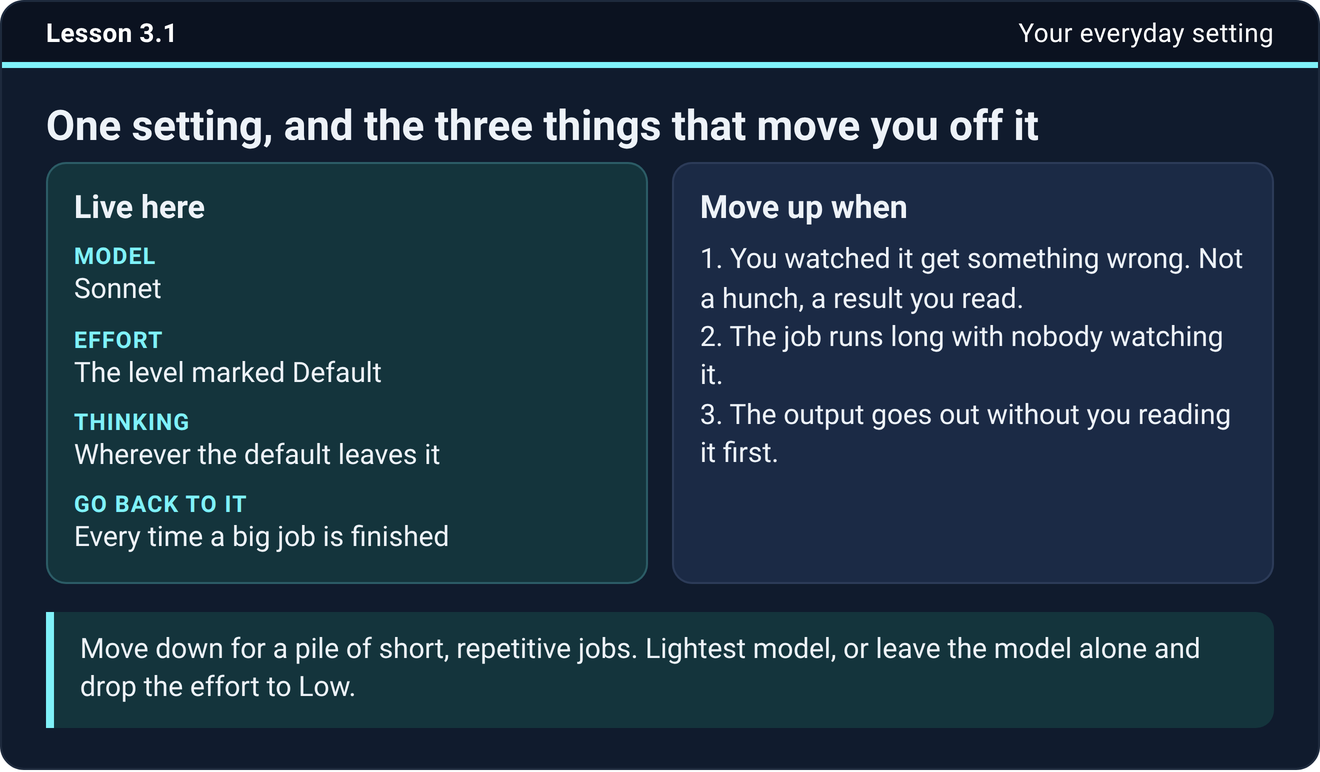
Start on the everyday model. Sonnet handles most of it, at the effort level marked Default in the menu, and you find out quickly when it does not.
Move up after you have watched it struggle, not before. Anthropic’s own guidance for Opus is problems where you tested with Sonnet and it struggled, and for Fable, problems where you tested with Opus and it struggled. Testing first is the whole instruction.
The three times you move up
You watched it get something wrong. That means you ran it, read the answer, and it was not good enough, rather than a hunch that the job looks hard. Move one model up and run it again.
The job runs long with nobody watching. Many steps, one instruction, and you are not going to check in halfway. That is what the heaviest model is built for, and it is the one case where paying more up front is cheaper than fixing it after.
The output goes out without you reading it, straight to a customer, into a document somebody signs, or onto a page that goes live. When a mistake is expensive and nobody is between the answer and the world, buy the extra care.
The one time you move down
It is a pile of short, repetitive, obvious jobs, like twenty emails you need a date pulled out of. Drop to the lightest model, or leave the model alone and drop the effort to Low. Your weekly limit will notice and the answers will not be any worse.
Two things people miss
The picker is sticky. Whatever you picked last is what your next conversation starts on, tomorrow, on a different job. So the heavy setting you used for one hard job on Monday is quietly running your twenty small jobs on Tuesday. Before anything big, read the picker. It takes two seconds.
Some models are missing from some plans, and the top one is paid for differently. On Pro, Haiku, Sonnet, and Opus are included, and Fable runs on usage credits, which is money on top of the subscription. On Max all four are included, with a cap on how much of the week can go to Fable before it moves to credits too. Read your own picker rather than a table, because this changes.
When the names change
Anthropic shipped thirteen models between May 2025 and September 2026, so any name in this post has a few weeks in it. The shape stays the same, with four families from lightest to heaviest, one everyday default, an effort dial with a Default badge, and a picker that remembers what you used last. When a new name shows up, check two things. Is your everyday model still at the top level of the picker, or has it moved down into More models? And has the Default badge on the effort menu moved? The picker is the only thing that shows what you can use today, on your plan, on your computer.
The next step
Set your picker to Sonnet at Default, and only move when one of the three triggers tells you to.
Pick the Right Claude is a free 45-minute course on all three settings, and every member of Teach Claude Your Business gets it the day they join. It is free to join.

