
Claude Opus 5.5 is here. What changes for a small business, and what does not.
On September 22, 2026, Anthropic shipped Claude Opus 5.5. It calls it the first model in a new Claude 5.5 family, and a major step up from Opus 5. I wrote about which Claude to use the day after, and that post listed Opus 5 as the model for complex work. So here is what the new one changes for a small business owner, and what it leaves alone.
I read Anthropic's announcement, its post on what a task costs, and the help center on September 24, 2026. The dates matter, because the names in the picker move, and parts of this post will be out of date in a few weeks.
What Opus 5.5 is, in plain words
Anthropic's own line is that Opus 5.5 performs at the level of Claude Fable 5.1 on most work and costs 40 percent less to run than Opus 5. Fable 5.1 is the heaviest model, the one for the toughest jobs, and until now the gap between it and Opus was the reason to pay for it.
Two more numbers are worth knowing. Anthropic says Opus 5.5 produces its answers more than 30 percent faster than Opus 5. And on the paid Claude plans, meaning Pro, Max and Team, it says the lower cost is passed on to your limits, so they go about 25 percent further than they did on Opus 5.
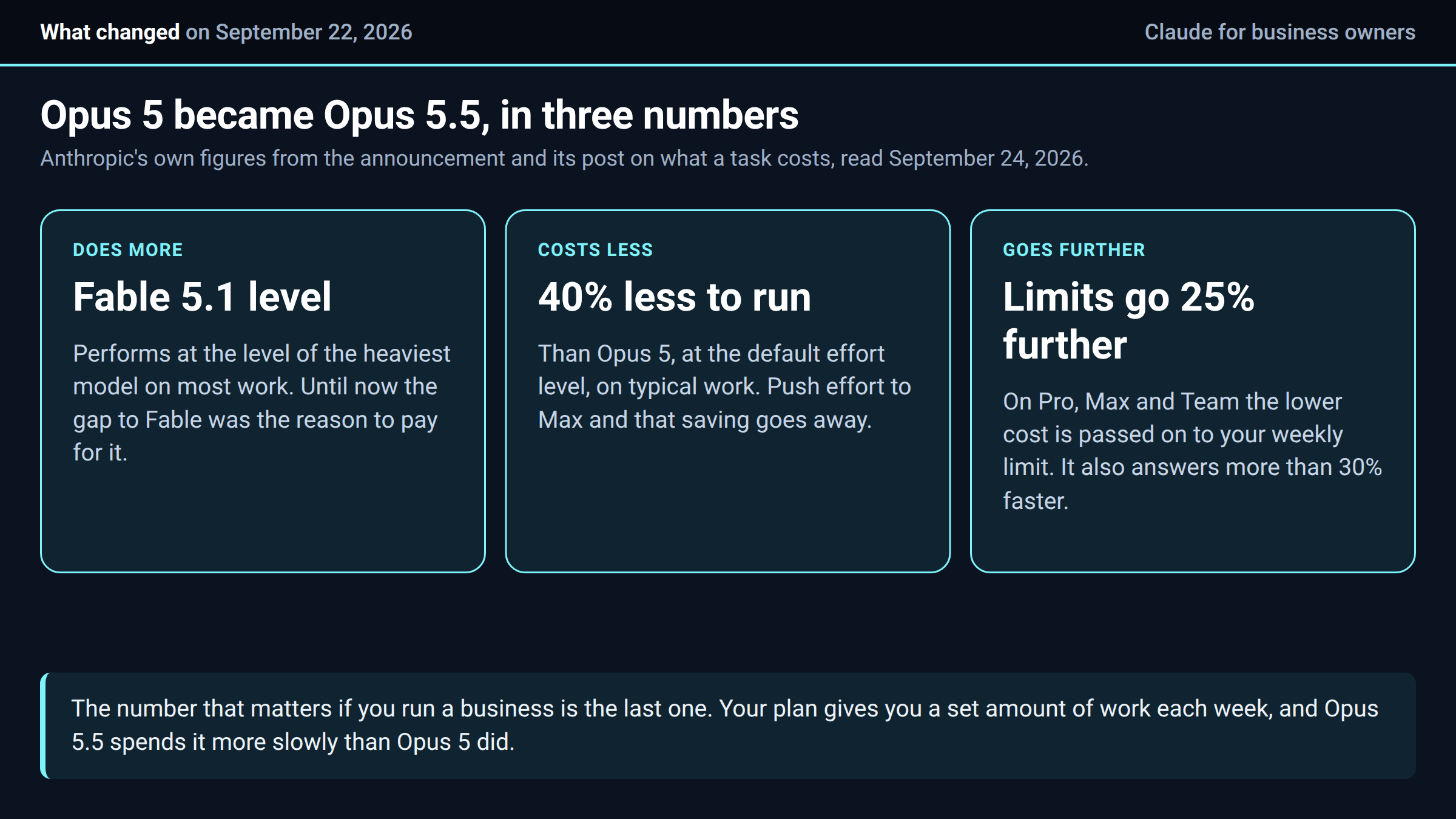
That last one is the number that matters if you run a business. Your plan gives you a set amount of work each week, and every model spends it at a different rate. The heavier the model, the faster it goes. Opus 5.5 spends it more slowly than Opus 5 did, while doing more with it.
Sonnet 5.5 and Haiku 5.5 are coming in the next few weeks, according to the announcement. So the whole ladder is about to get new names, one rung at a time.
What it means for your picker
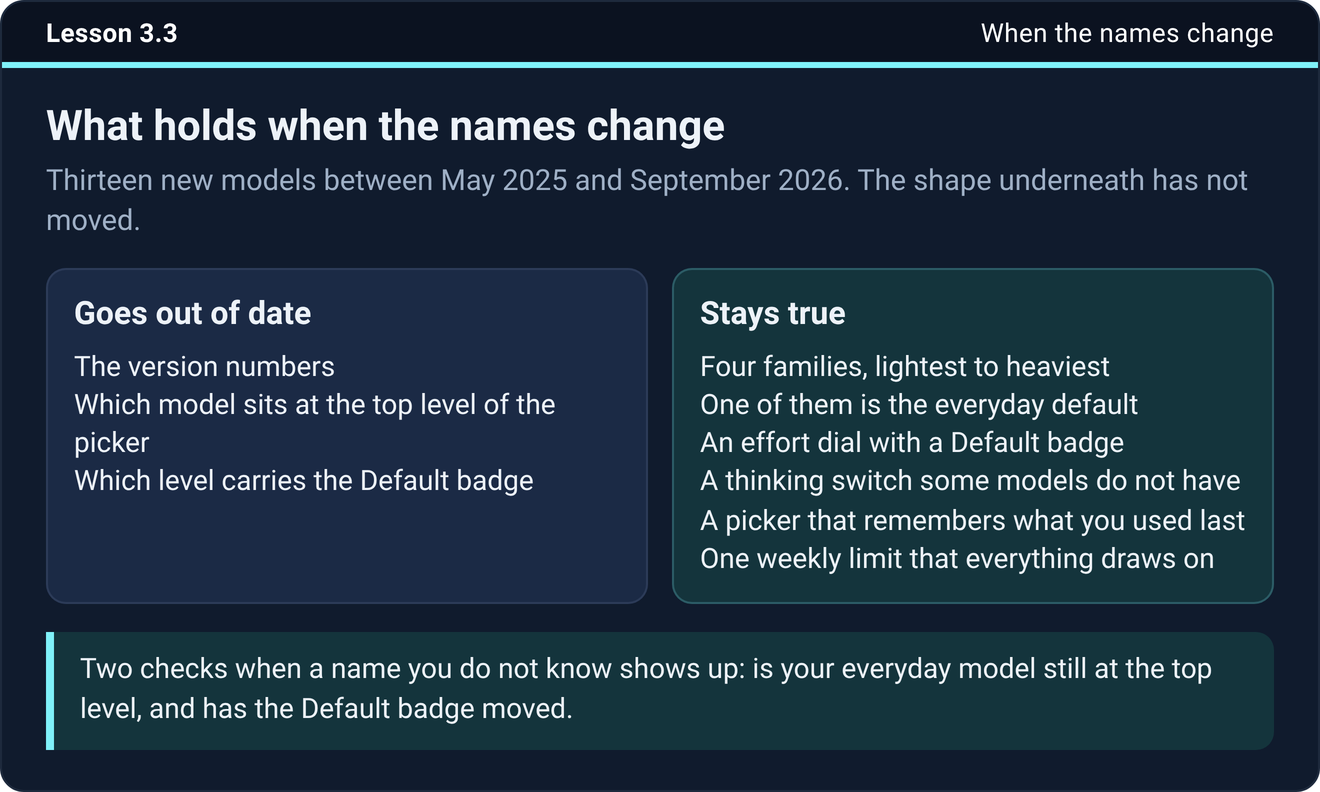
The picker is the small piece of text next to the send button. It shows the model, the effort level, and whether thinking is on. On September 24, 2026, Anthropic's pricing page lists Opus on Pro, Max, Team and Enterprise, and not on Free, and its help center already names Opus 5.5 in the article on changing the model. Open your own picker and read what it says. If Opus 5.5 is in the list, you have it. If it still reads Opus 5, give it a few days and check again.
One setting behaves differently on this model. Anthropic's help center says thinking cannot be turned off when you are using Opus 5.5, the same as on Opus 5 and Fable 5.1. On those models the switch is simply not there. That is fine for the kind of work you would send to Opus anyway, which is work worth thinking through.
The effort menu still applies. The announcement says the cost comparison holds at the default effort level, which is the one marked Default in the menu. Push it to Max and you are back to spending your limit fast, on any model.
What does not change
The two rules from the September 23 post still hold, and Opus 5.5 does not touch them.
Start on the everyday model. Sonnet handles most of what a business owner asks for in a day, and you find out quickly when it does not.
Move up after you have watched it struggle, not before. That was Anthropic's own guidance for moving to Opus, and it still is. What changed is the cost of the move. Going up to Opus is cheaper than it was, and the reason to go all the way to Fable is smaller than it was, because Opus 5.5 now does most of that work.
Anthropic's post on what a task costs says it plainly, in its own words for developers. Opus 5.5 is for work you supervise. Fable 5.1 is for when the result matters more than the token price, such as long runs you will not be watching. Sonnet and Haiku are for lookups and summaries. Read that with a business owner's jobs in mind and it is the advice from the September 23 post. The proposal you will read before it goes out is an Opus job. The overnight run that touches twelve files and sends nothing until you look is the one to think hard about. The twenty emails you need a date pulled out of are a Haiku job.
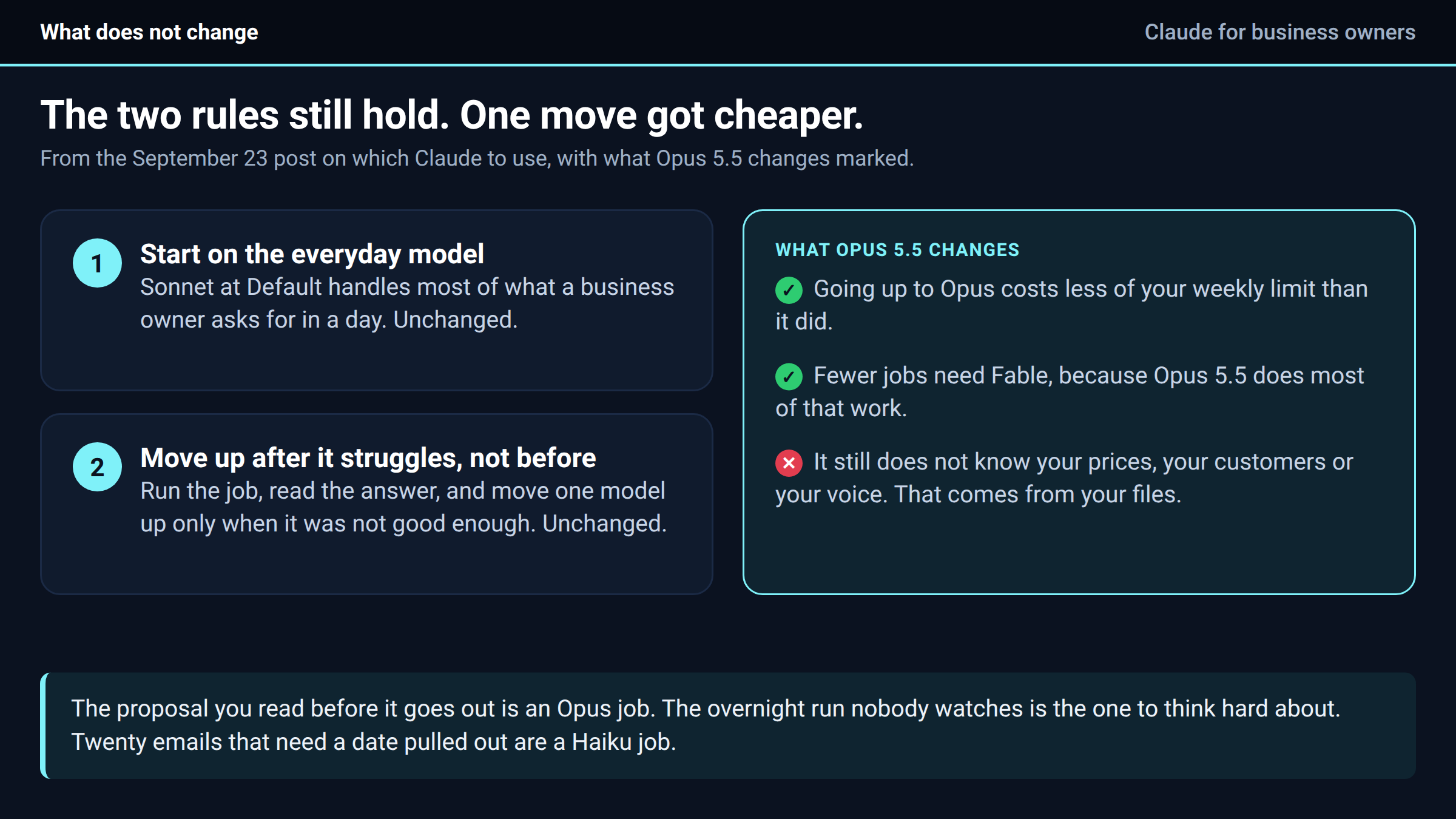
Heavier still does not mean smarter about your business. Opus 5.5 does not know your prices, your customers, or how you write, any more than Opus 5 did. That comes from the files Claude reads at the start of a job. A new model on an empty setup writes the same template with blanks that the old one did, a little faster.
What to do this week
Read your picker before your next real job. It is sticky, so whatever you set it to for the last hard task is what the next twenty small ones will run on.
If Opus 5.5 is there and you have a job that Sonnet got wrong last week, run that job again on Opus 5.5 and compare. That is the whole test. Do not move your everyday setting up because a new model shipped.
If you have a scheduled task pinned to Opus 5 by name, open it. The mini course covers this in lessons 3.2 and 3.3, and the short version is that Anthropic retires old models, historically about a year after they launch, so a task pinned to a name is worth opening on the day a new name shows up. I cover scheduled tasks on Wednesday.
The next step
Set your picker to Sonnet at Default, and let the three triggers from the September 23 post tell you when to move.
Pick the Right Claude is a free 45-minute course on the model, the effort level and the thinking switch, and every member of Teach Claude Your Business gets it the day they join. It is free to join.
Join Teach Claude Your Business
Sources: Introducing Claude Opus 5.5, Anthropic, September 22, 2026. What a task costs on Opus 5.5, Anthropic, September 22, 2026. Change the model, effort, and thinking settings, Claude help center, read September 24, 2026. Which Claude should you use?, this blog, September 23, 2026.

