
Claude Sonnet 5.5 is here. The everyday model got faster and cheaper.
On September 28, 2026, Anthropic shipped Claude Sonnet 5.5. Six days earlier it shipped Opus 5.5, and I wrote last Monday that Sonnet and Haiku would follow. Sonnet is the one that matters most to a business owner, because it is the model I have told you to run everything on until something tells you to move. So here is what changed, what moved in the picker, and what does not change at all.
I read Anthropic's announcement and the help center on September 29, 2026. The dates matter, because the names in the picker move and part of this will be out of date in a few weeks.
What Sonnet 5.5 is, in plain words
Anthropic calls it the second model in the Claude 5.5 family and a clear upgrade over Sonnet 5. Its own two numbers are that it runs more than 30 percent faster and costs up to 30 percent less for most work.
The line I would underline is the one about what it is for. Anthropic says Sonnet 5.5 is strongest at well-scoped everyday tasks, fixing bugs, and creating polished documents, slides and spreadsheets. It also says the model writes more clearly than the previous generation, and that early testers found it a better partner for working together than Sonnet 5. Read that with your week in mind, because the customer reply, the proposal draft, the weekly update and the spreadsheet you need cleaned up are all on that list, and Sonnet was already the model handling them.
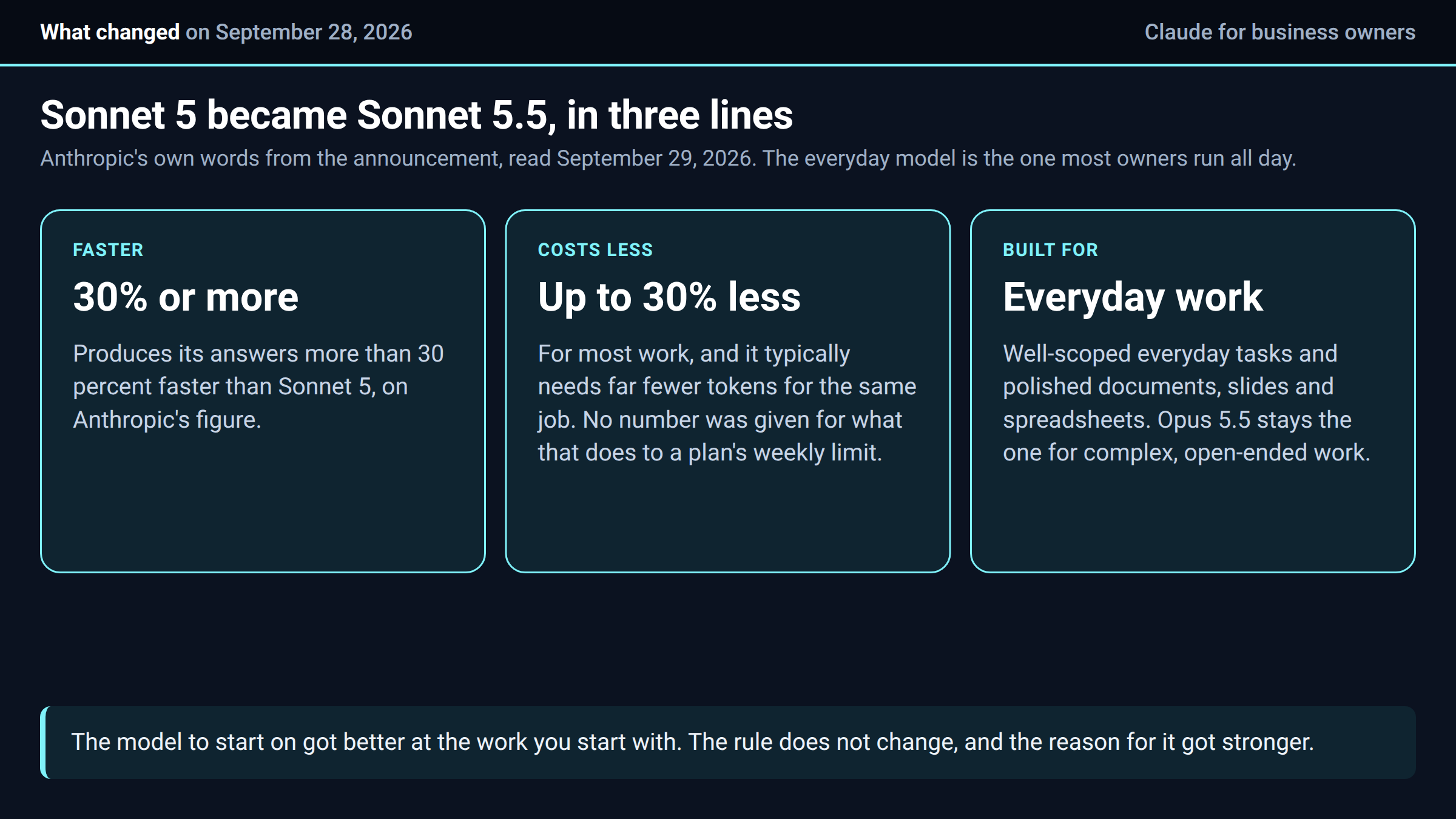
Anthropic is careful about where the line sits. It says Opus 5.5 remains clearly stronger at complex, open-ended work that needs sustained judgment. That is the same split as before, with new names on both sides. The everyday model got better at everyday work, and the heavy model is still the one for the contract you will argue with.
Haiku 5.5 is coming in the next few weeks, according to the announcement.
What it means for your limits
The Opus 5.5 announcement gave a number for how much further your plan's limits would go. The Sonnet 5.5 announcement does not. What it does say is that the model typically needs far fewer tokens to do the same work, and that it costs up to 30 percent less for most work. On a plan with a weekly limit, a model that spends fewer tokens on the same job is a model that leaves more of your week for other jobs. How much more, Anthropic has not said for the apps, so I will not put a number on it either.
On September 29, 2026, Anthropic's pricing page lists Sonnet on every plan, Free included, and its help center already names Sonnet 5.5 in the article on changing the model. Which version of Sonnet the Free plan gets is not stated on the pricing page, so read your own picker rather than a table.
The one switch that moved
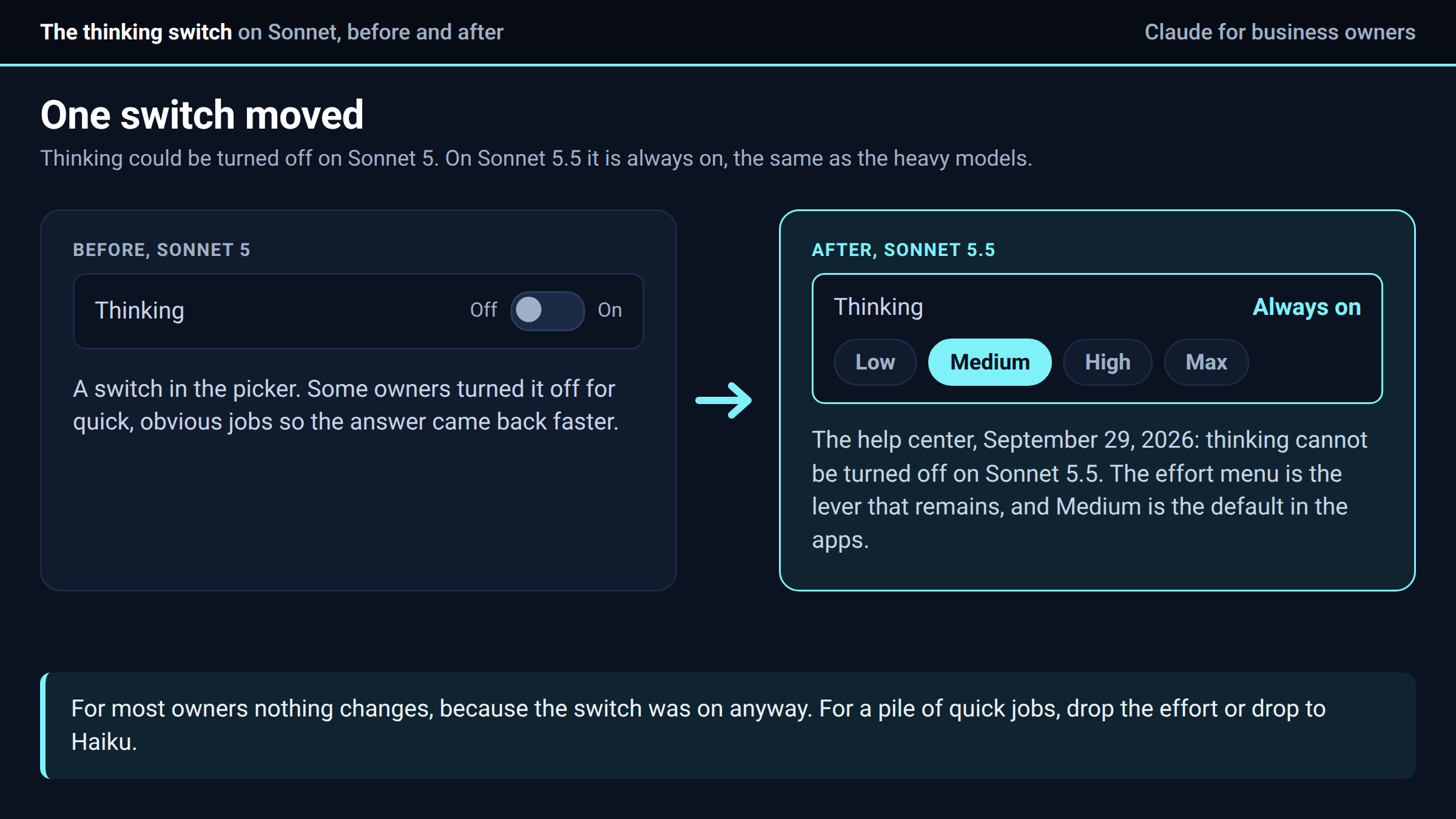
Here is the change that will surprise people who read my Opus 5.5 post. In that post I said thinking cannot be turned off on Opus 5.5, Opus 5 and Fable 5.1, and that on those models the switch is simply not there. On September 29, 2026, the help center says the same of Claude Sonnet 5.5. The everyday model is now on that list too.
For most business owners this changes nothing, because the switch was on anyway. If you did turn it off on Sonnet 5 for quick, obvious jobs, that lever is gone on Sonnet 5.5, and the effort menu is the lever that remains. Anthropic says the default effort in the Claude apps is Medium for this model, and that at lower settings it answers faster and uses fewer tokens, which suits routine work. So the way to make a quick job quick on Sonnet 5.5 is the effort menu, or a drop to Haiku, and lesson 2.2 of the mini course covers exactly this.
What does not change
The two rules from the September 23 post hold, and I will keep repeating them every time a name changes.
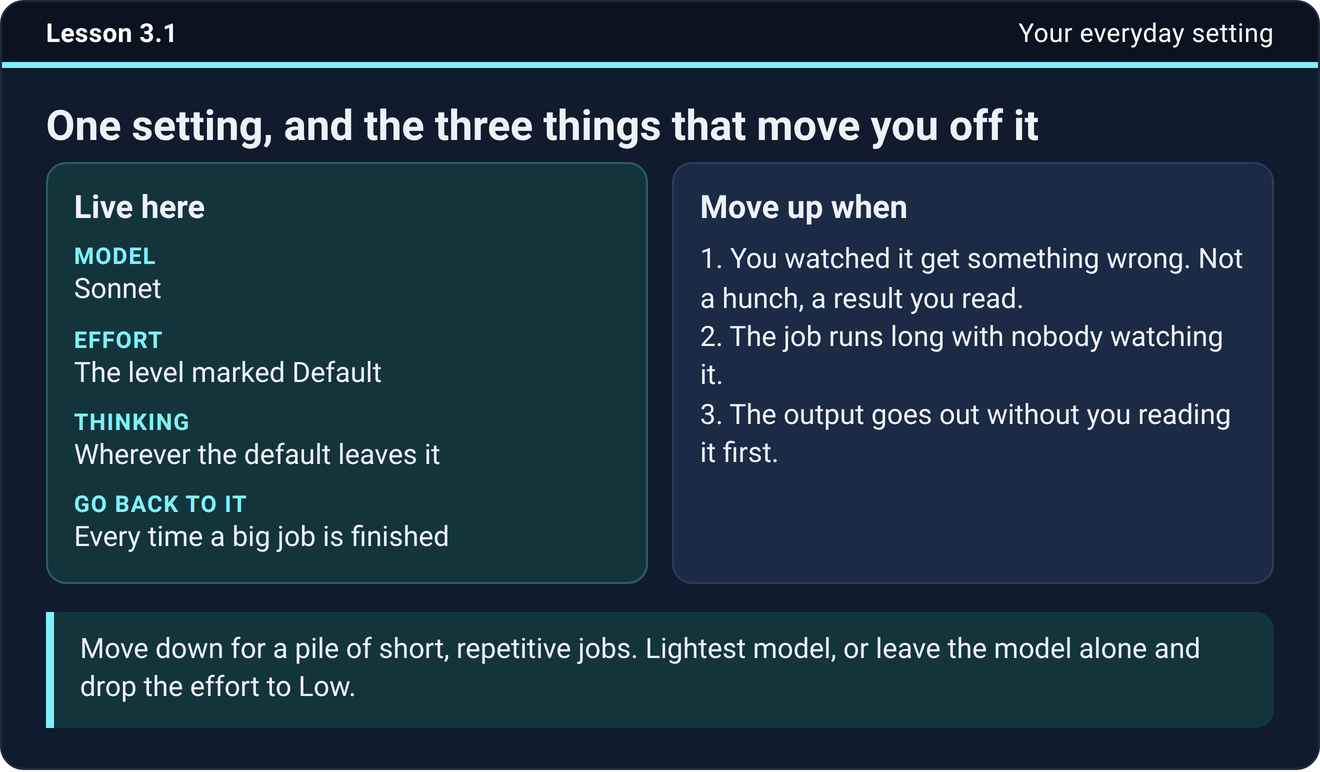
Start on the everyday model. That model is now called Sonnet 5.5, and the reason to start there is stronger than it was, since it does the everyday work faster and for less.
Move up after you have watched it struggle, not before. A better Sonnet means you will move up less often, not that you should stop testing. When a job comes back wrong twice on Sonnet 5.5, run it on Opus 5.5 and compare. When it comes back right, leave your picker alone.
There is also the rule that never changes with a model release. A faster Sonnet does not know your prices, your customers or how you write. Anthropic's line about polished documents is about the quality of the document, not about whether it says the right things about your business. That part comes from the files Claude reads at the start of a job. On an empty setup, Sonnet 5.5 writes the same template with blanks in it that Sonnet 5 did, in less time.
What to do this week
Read your picker before your next real job. It is sticky, so it is sitting on whatever you last set it to. If it reads Sonnet 5.5, you have the new one. If it still reads Sonnet 5, give it a few days and check again.
If you had a scheduled task pinned to Sonnet 5 by name, open it now. Lesson 3.3 of the mini course is about this, and the short version is that Anthropic retires old models, historically about a year after they launch, so a task pinned to an old name is worth opening on the day the new name shows up. A task left on Default model follows your picker, which is one more reason to check what the picker says.
Then run one of last week's real jobs again, on Sonnet 5.5 at Default effort, and read the result against last week's. That is the whole test, and it takes five minutes.
The next step
Set your picker to Sonnet 5.5 at Default effort, and let the three triggers from the September 23 post tell you when to move.
Pick the Right Claude is a free 45-minute course on the model, the effort level and the thinking switch, and every member of Teach Claude Your Business gets it the day they join. It is free to join.
Join Teach Claude Your Business
Sources: Introducing Claude Sonnet 5.5, Anthropic, September 28, 2026. Release notes and Change the model, effort, and thinking settings, Claude help center, both read September 29, 2026. Which Claude should you use?, this blog, September 23, 2026, and Claude Opus 5.5 is here, this blog, October 5, 2026.

